
What Size Welding Table Do I Need? (Complete 2026 Buyer’s Guide)
Updated: Apr 21
Choosing the right welding table size is one of the most important decisions for any workshop. Whether you are a small fabricator or a large production facility, the correct table size directly impacts efficiency, accuracy, and productivity.
In this complete guide, we’ll help you understand exactly what size welding table you need based on your work, space, and budget.
Why Welding Table Size Matters
A welding table is not just a surface — it’s your fixture foundation.
Choosing the wrong size can cause:
❌ Limited working space
❌ Poor clamping flexibility
❌ Lower efficiency
❌ Rework due to misalignment
The right size gives you:
✅ Faster setup
✅ Better precision
✅ More flexibility with fixtures
✅ Higher productivity

Standard Welding Table Sizes (Most Popular Options)
Here are the most commonly used 3D welding table sizes in the industry:
Size (mm) | Size (inch approx.) | Best For |
1200 × 800 | 47” × 31” | Small parts, hobby use |
1500 × 1000 | 59” × 39” | Light fabrication |
2000 × 1000 | 79” × 39” | General workshop use |
2400 × 1200 | 94” × 47” | Medium fabrication |
3000 × 1500 | 118” × 59” | Large structures |
4000 × 2000 | 157” × 79” | Heavy industrial work |
👉 Tip: If you are unsure, 2000×1000 mm is the most versatile choice for most workshops.
Table size also affects precision, so it’s important to understand welding table flatness before making a final decision.

How to Choose the Right Welding Table Size
1. Consider Your Workpiece Size
Your table should always be larger than your typical parts.
✔ Rule of thumb:👉 Table size = workpiece size + 300–500 mm margin
Example:
Workpiece: 1500 mm
Recommended table: 2000 mm
2. Think About Future Projects
Many buyers make the mistake of choosing only for current needs.
👉 Ask yourself:
Will you take bigger jobs in the future?
Will your production scale?
✔ Smart strategy:
Always go slightly bigger to avoid upgrading later.
3. Workshop Space Limitations
Measure your workshop carefully.
You need space for:
Operator movement
Clamping access
Material handling
✔ Recommended clearance:👉 At least 800–1000 mm around the table
4. Number of Operators
1 operator → smaller table OK
Multiple operators → larger table required
👉 Example:
1 person → 1500×1000 mm
2–3 people → 2400×1200 mm or bigger
5. Modular vs Single Table
Instead of one large table, consider modular setups:
Combine multiple tables
Add extension blocks
Increase flexibility
👉 This is ideal for:
Growing workshops
Custom fabrication

System 16 vs System 28 (Size Impact)
Your table system also affects size selection:
🔹 System 16 (D16)
Hole diameter: 16 mm
Smaller tables
Light-duty applications

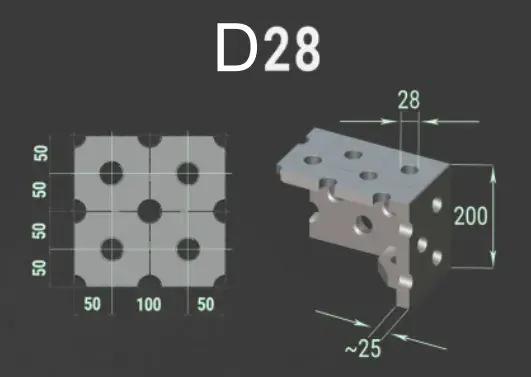
🔹 System 28 (D28)
Hole diameter: 28 mm
Stronger and more versatile
Ideal for medium to heavy fabrication
👉 Recommendation:Most professional workshops choose System 28 for flexibility and strength.
Common Mistakes to Avoid
❌ Choosing too small → limits your work
❌ Ignoring future needs → costly upgrade later
❌ Not considering accessories space
❌ Forgetting operator movement
Pro Tip (From Real Workshops)
Many experienced fabricators say:
👉 “Buy the biggest table your space and budget allow.”
Why?
More flexibility
Less repositioning
Faster workflow
Recommended Sizes Based on Use
Small Workshop / DIY
✔ 1200×800 mm or 1500×1000 mm
General Fabrication
✔ 2000×1000 mm (best seller)
Heavy Fabrication
✔ 2400×1200 mm or 3000×1500 mm
Industrial Production
✔ 4000×2000 mm or modular setup
Shipping & Practical Considerations
When choosing size, also consider:
Transport cost
Installation space
LCL vs full container shipping
👉 Larger tables = higher shipping cost
👉 Modular tables = easier logistics
Why Table Size Affects Productivity
A properly sized welding table can:
Reduce setup time by 30–50%
Improve accuracy
Increase output
👉 This is why professionals invest in the right size early.
Get the Right Welding Table for Your Needs
Not sure which size is best for your project?
We can help you choose the perfect solution based on your:
Workpiece size
Workshop layout
Budget
Surface treatment also plays a role in durability, so you may want to compare nitrided vs standard welding tables before choosing.
👉 Contact us today for a free recommendation and quotation
📧 Email: sales@canadaweldingtable.com
📱 WhatsApp: +86-180-2874-2690
We ship directly to Canada, USA, Mexico, and worldwide.

FAQ – Welding Table Size
1. What is the most popular welding table size?
👉 The most popular size is 2000×1000 mm, as it balances space, cost, and flexibility.
2. Can I combine multiple welding tables?
👉 Yes. Modular tables allow you to expand your workspace easily.
3. Should I choose a bigger welding table?
👉 If space and budget allow, yes. A larger table improves efficiency and flexibility.
4. What size welding table do professionals use?
👉 Most professionals use:
2000×1000 mm
2400×1200 mm
3000×1500 mm
5. Does table thickness matter with size?
👉 Yes. Larger tables usually require thicker material to maintain flatness and load capacity.


Comments